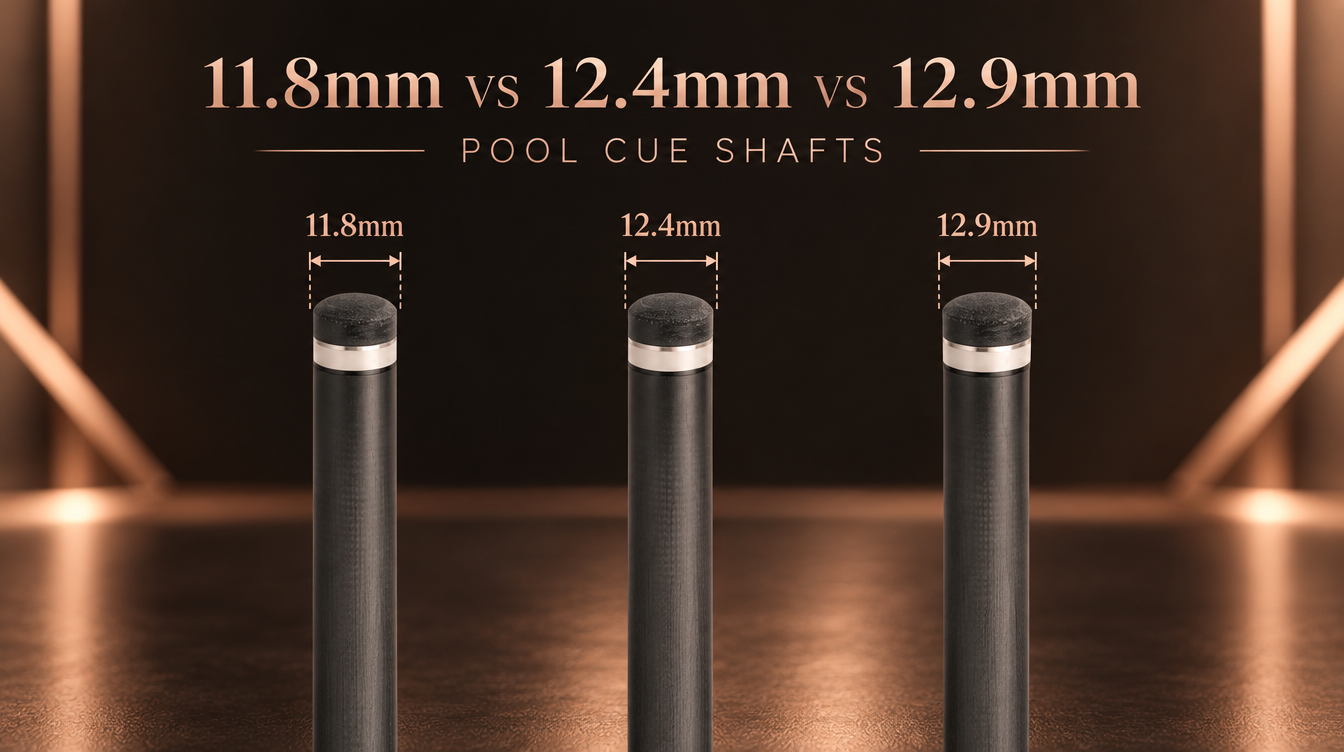
Choosing between 11.8mm, 12.4mm, and 12.9mm pool cue shafts involves more than tip diameter. In modern pool, a shaft’s performance depends on its overall engineering, including stiffness, taper, weight distribution, front-end design, and tip system. Carbon fiber technology gives manufacturers greater control over these characteristics, but the material alone does not determine how a shaft plays.
The Engineering Behind a Pool Cue Shaft
A carbon fiber pool cue shaft is an engineered composite structure. Its internal construction, wall thickness, mass distribution, and manufacturing consistency all influence performance.
Even shafts with similar dimensions and materials can deliver different playing experiences. Understanding these differences helps players make informed decisions based on their playing style, stroke mechanics, and performance preferences.
What Players Notice on the Table
The shaft influences how a cue feels and responds during play. Players may notice differences in cue-ball control, feedback, sound, vibration, and consistency.
Diameter also affects bridge feel and the player’s perception of the shaft. A thinner shaft may feel more precise in the bridge hand, while a thicker shaft may feel more substantial. However, neither diameter automatically guarantees better accuracy or control. Taper, stiffness, and individual preference also matter.
Shaft Diameter and Cue-Ball Deflection
One important consideration when comparing 11.8mm vs 12.4mm vs 12.9mm pool cue shafts is cue-ball deflection, commonly called squirt. When a player strikes the cue ball off-center to apply sidespin, the cue ball initially travels away from the intended line.
Shaft design, particularly the effective mass of the front end, influences the amount of squirt. Tip offset, shot speed, cue elevation, and other playing conditions also affect the result.
A smaller diameter does not automatically mean lower deflection. Actual performance depends on the complete shaft design, not diameter alone.
How to Choose the Right Shaft
When comparing high-performance pool cue shafts, consider the following factors:
Diameter: Choose a size that feels comfortable in your bridge and suits your preferred tip setup.
Deflection: Evaluate how the shaft responds to off-center hits and sidespin.
Taper and stiffness: Consider how the shaft moves through your bridge and feels during your stroke.
Feedback: Pay attention to impact feel, sound, and vibration.
Consistency and durability: Look for reliable manufacturing quality and performance over time.
Personal preference: Test different shafts with your own stroke and playing style whenever possible.
Rather than relying on diameter or material claims alone, compare specific shafts under similar conditions. A shaft that performs well for one player may not be the best fit for another.
Frequently Asked Questions
Is a carbon fiber pool cue shaft automatically better than a wood shaft?
No. Carbon fiber offers different engineering possibilities, but overall performance depends on design, construction, manufacturing quality, and player preference.
Does a thinner shaft produce less cue-ball deflection?
Not necessarily. Diameter is only one design variable. Front-end effective mass and the shaft’s overall construction play important roles in determining deflection.
Does technique still matter when using a high-performance shaft?
Absolutely. Stroke mechanics, tip placement, and a player’s ability to adjust for deflection remain essential to consistent pool play.
The ULTRA Perspective
At ULTRA, we believe advanced cue technology is about more than materials or measurements. It is about engineering the complete performance system—from shaft geometry and internal construction to manufacturing precision and quality control.
The real value of a high-performance carbon fiber pool cue shaft lies in how consistently its design translates into performance on the table. Understanding the relationship between diameter, deflection, feel, and construction helps players choose equipment with confidence.
The cue tip is the only part of the cue that directly contacts the cue ball. That small contact surface has a major job: it must accept chalk, create reliable friction at impact and transfer the player’s stroke into the cue ball consistently.
A pool cue is a system, not just a shaft or butt. The way the shaft, tip, joint, butt, weight and optional extension work together influences how the cue feels in your hands and how naturally you can deliver it through the cue ball.