Are carbon fiber pool cue shafts worth it? For many pool players, the answer depends on how the shaft is engineered, how it plays, and whether its performance matches their playing style. Carbon fiber has expanded the possibilities of modern cue design, but the material alone does not guarantee better results.
Should beginners use carbon fiber shafts when choosing their first pool cue? Carbon fiber has become a popular material in modern pool cue technology, offering new possibilities for shaft engineering, consistency, and performance. However, whether a carbon fiber pool cue shaft is the right choice for a beginner depends on more than the material alone.
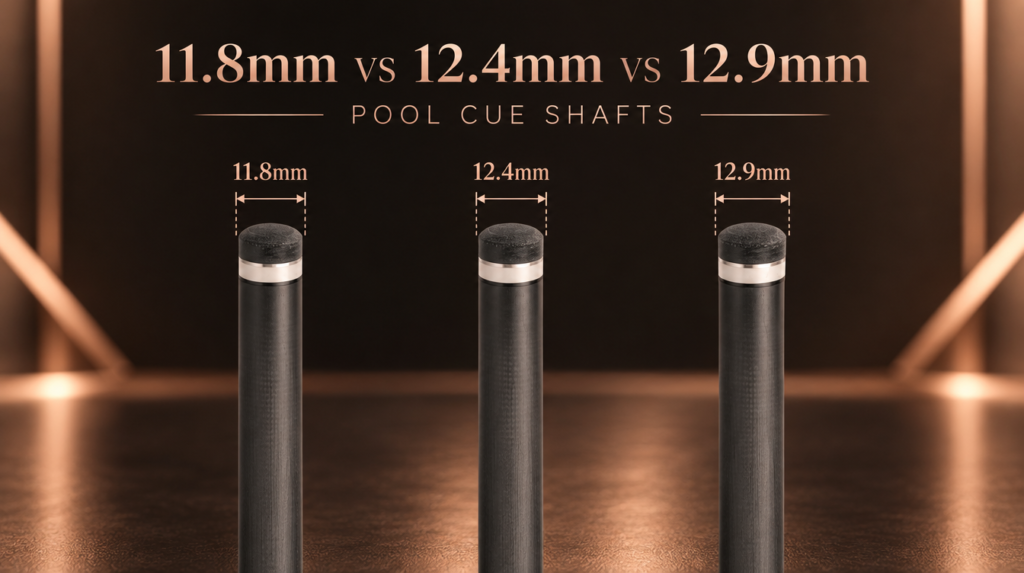
Choosing between 11.8mm, 12.4mm, and 12.9mm pool cue shafts involves more than tip diameter. In modern pool, a shaft’s performance depends on its overall engineering, including stiffness, taper, weight distribution, front-end design, and tip system. Carbon fiber technology gives manufacturers greater control over these characteristics, but the material alone does not determine how a shaft plays.
Choosing the right pool cue shaft diameter can influence your bridge feel, cue-ball control, and overall playing experience. With advances in carbon fiber technology, modern pool cue shafts offer greater opportunities for precision engineering. However, diameter alone does not determine performance. The shaft’s construction, taper, stiffness, weight distribution, and tip system all play important roles.
Choosing the right carbon fiber shaft is an important decision for any pool player looking to improve consistency, control, and confidence at the table. While carbon fiber has expanded the possibilities of modern cue technology, the material alone does not determine performance. The shaft’s engineering, construction, and overall design play equally important roles.
Robot testing vs. human testing is an important topic in modern pool cue technology. Carbon fiber has given cue engineers greater control over shaft performance, but the material alone does not determine how a shaft plays. Understanding the differences between laboratory measurements and real-world playing experience helps players make more informed equipment choices.
Carbon fiber has changed the way modern pool cue shafts are engineered. Its strength, stiffness, and design flexibility allow manufacturers to fine-tune shaft performance in ways that go beyond traditional materials. But when it comes to a carbon fiber pool cue shaft, wall thickness is only one part of the equation.
Radial consistency in carbon fiber shafts is an important consideration in modern pool cue engineering. Carbon fiber has opened new possibilities for designing high-performance pool cue shafts, but the material alone does not determine how a shaft plays. Its construction, weight distribution, stiffness, and manufacturing quality all contribute to its performance.
Front-end mass matters because it influences how a pool cue shaft responds on off-center hits. As carbon fiber pool cue shafts continue to evolve, shaft engineering plays an increasingly important role in deflection, consistency, and overall playing performance. However, carbon fiber alone does not guarantee a better-performing shaft. The complete design makes the difference.
How ferrule design affects deflection is an important topic in modern pool cue engineering. While carbon fiber has opened new possibilities for high-performance shafts, the material alone does not determine how a cue plays. Ferrule design, front-end mass, shaft geometry, stiffness, and tip construction all influence cue-ball response.